What if the $200 you spend on a mechanic's review was actually the most profitable investment of your year? Most buyers view a mechanical check as a simple safety net, but savvy shoppers know exactly how to use pre-purchase inspection to negotiate thousands off the sticker price. It's completely natural to feel anxious about confrontational talks or worry that you're overpaying for a vehicle that might need a $4,000 engine replacement next month. You deserve to feel protected and prioritized during such a high-stakes transaction.
This guide will show you how to transform a technical report into a powerful financial tool that secures the best possible deal on your next vehicle. We'll simplify the process of identifying which mechanical issues warrant a discount and show you how to present those facts to a seller with calm confidence. We'll walk through the current repair costs for 2026, the latest FTC transparency rules, and the exact steps you need to take to ensure your next car is a sound investment rather than a financial burden.
Key Takeaways
- Learn how to treat your inspection report as a strategic ledger that establishes the vehicle's true market value before you sign any paperwork.
- Discover exactly how to use pre-purchase inspection to negotiate by presenting mechanical findings as objective, third-party realities that lower the seller's defenses.
- Understand the importance of obtaining itemized repair estimates to provide a clear, data-backed foundation for your price reduction requests.
- Identify the non-negotiable mechanical red flags, such as structural damage or flood history, that signal it's time to walk away from a potential purchase.
- Gain the confidence to protect your long-term investment by recognizing and avoiding the common psychological trap of the sunk cost fallacy.
Transforming Your PPI Report into a Strategic Negotiation Plan
A pre-purchase inspection acts as a fiduciary tool, providing you with an objective baseline for a vehicle’s true market value. Understanding What is a Pre-Purchase Inspection? allows you to step away from emotional guesswork and move toward a factual assessment of the car's health. When you receive your report, you aren't just looking for a "pass" or "fail" grade; you're looking for an itemized ledger of the vehicle's actual condition. This transparency creates a sense of calm confidence, ensuring you won't be surprised by hidden costs after the sale is finalized.
To better understand how this report functions in a real-world scenario, watch this helpful video:
Securing an itemized repair estimate alongside the inspection report is vital for your success. This document translates mechanical jargon into specific dollar amounts, which is exactly how to use pre-purchase inspection to negotiate with a seller. A negotiable fault is any item requiring immediate or near-term capital expenditure not disclosed in the listing. By holding this data, you shift your mindset from "asking for a favor" to simply "adjusting the price to reflect reality." If you find the technical details daunting, a professional car negotiator can step in to manage these complex discussions for you.
Categorizing Findings: Safety, Maintenance, and Deal-Breakers
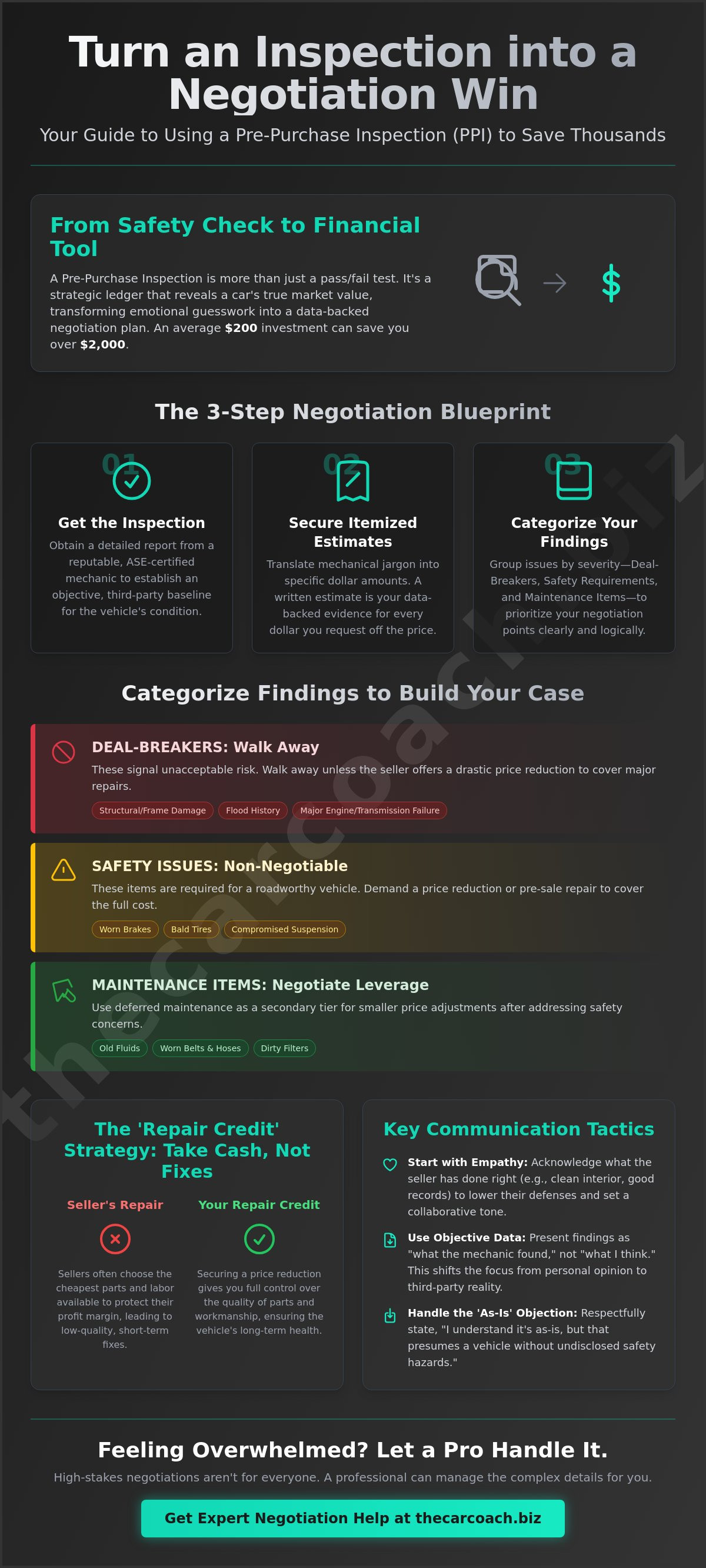
It's helpful to group the findings into three distinct tiers to stay organized during the closing process. Safety issues, such as worn brakes, bald tires, or compromised suspension, are non-negotiable requirements for a roadworthy sale. These should be addressed immediately through a price reduction or a pre-sale repair. Deferred maintenance, like old fluids or filters, serves as a secondary tier for smaller price adjustments. Finally, major mechanical failures, such as transmission slips or poor engine compression, should be flagged as immediate exit points unless the seller is willing to slash the price drastically to account for the significant risk.
How to Communicate PPI Findings for Maximum Price Reduction
Effective communication begins with empathy. Before you present your findings, validate the seller's position by acknowledging the things they've done right, such as maintaining a clean interior or keeping detailed service records. This lowers their defensive guard and sets a collaborative tone for the rest of the conversation. Once you've established rapport, present the inspection findings as an external, third-party reality rather than your personal opinion. This shift allows you and the seller to look at the data together, focusing on objective facts instead of personal feelings.
Learning how to use pre-purchase inspection to negotiate effectively involves shifting the focus from your perspective to the mechanic's professional data. You should always be prepared to provide a written estimate from a reputable ASE-certified mechanic to justify every dollar you request. This level of precision shows the seller that your request is grounded in market reality, not a random guess. If the thought of these high-stakes conversations brings you stress, you might consider reaching out for professional car buying assistance to handle the heavy lifting for you.
The 'Repair Credit' Strategy: Why You Want Cash, Not Fixes
We recommend the 'Repair Credit' approach, which involves asking for a price reduction rather than asking the seller to perform the repairs themselves. When a seller fixes a car they're about to part with, they often choose the cheapest parts and labor available to protect their profit margin. By securing a price adjustment, you ensure the work is done to your specific standards with quality components you trust. A professional car negotiator can help you frame this request by explaining that you'd prefer to take responsibility for the repairs to ensure the vehicle's long-term health and safety.
Handling the 'As-Is' Objection with Professional Grace
Sellers often lean on the 'As-Is' nature of the sale to avoid price drops. You can rebut this with professional grace by stating that you respect the as-is nature, but that assumes a vehicle without undisclosed safety hazards. This isn't an attack on the seller's integrity; it's a simple matter of market value. A car needing $2,000 in steering repairs is mathematically worth less than the 'Good Condition' value listed in pricing guides. FTC guidance on negotiations confirms that independent inspections are a buyer's right, and those findings are a valid reason to revisit the final price before the sale is finalized.
Navigating Deal-Breakers and Knowing When to Walk Away
Sometimes, the most powerful move you can make in a dealership is to walk away. While the primary goal is to secure a fair price, some mechanical findings represent a risk that no discount can justify. Understanding how to use pre-purchase inspection to negotiate also means recognizing when a vehicle's foundation is fundamentally compromised. Your long-term financial health and peace of mind depend on your ability to distinguish between a fixable maintenance issue and a permanent liability.
It's easy to fall into the trap of the "sunk cost fallacy," where you feel obligated to buy the car because you've already spent approximately $200 on an inspection. In reality, that fee is a protective investment. Spending a few hundred dollars to avoid a $10,000 mistake is one of the smartest financial decisions you can make. For more detailed strategies on interpreting these reports, you can consult this guide to negotiating with a PPI report.
The 'Money Pit' Checklist: Non-Negotiable Red Flags
Certain discoveries should serve as an immediate signal to end the transaction regardless of the seller's promises. We recommend walking away if the inspection reveals:
- Frame or unibody damage: Structural issues compromise the vehicle's safety integrity and are often impossible to truly "fix" to factory standards.
- Major engine or transmission failures: Head gasket leaks or internal gear wear suggest a history of poor care and lead to astronomical repair bills.
- Odometer or record discrepancies: Inconsistent service records or signs of odometer tampering indicate a high risk of undisclosed problems.
Securing Professional Advocacy for Your Next Purchase
You don't have to navigate these high-stakes decisions alone. Bill Flower at The Car Coach uses 33 years of industry experience to interpret PPI findings and silence dealer pushback. Having a professional car negotiator acts as a protective buffer between you and the high-pressure dealership environment. This partnership ensures that you only invest in a vehicle that has been thoroughly vetted by an expert who prioritizes your safety and financial security. Secure your professional vehicle purchase assistance today and drive away with the confidence that you've secured the best possible deal.
Drive Away with Absolute Peace of Mind
Mastering the car buying process means shifting the power balance back in your favor. By treating a mechanical report as a strategic ledger rather than just a health check, you establish an objective baseline for the car's true value. You now understand how to use pre-purchase inspection to negotiate by categorizing findings into safety requirements and maintenance credits, ensuring every dollar of the final price is justified by data. Most importantly, you have the tools to recognize when a "deal" is actually a liability and the strength to walk away from structural red flags.
You don't have to face the dealership alone. With over 33 years of dealership insider experience, Bill Flower provides national service coverage across the United States to protect your interests. We handle the heavy lifting by providing expert negotiation on price, trade-ins, and financing, allowing you to enjoy a simplified, stress-free journey. Let The Car Coach handle the negotiation for you so you can focus on the excitement of your new vehicle. Your next car should be a source of joy, not a source of stress, and we're here to ensure it stays that way.
Frequently Asked Questions
Is it worth getting a PPI if the car has a clean Carfax report?
Yes, a professional inspection is essential even with a clean vehicle history report. Reports like Carfax only reflect data that has been officially reported to insurance companies or police departments. They often miss mechanical wear, poor maintenance habits, or minor collisions repaired out-of-pocket. A physical check by a mechanic ensures you aren't inheriting hidden problems that could cost thousands in future repairs. This step provides the transparency you need to feel protected.
What happens if the seller refuses to allow a pre-purchase inspection?
If a seller refuses to allow an independent inspection, you should view this as a significant warning sign and be prepared to walk away. Legitimate sellers who are confident in their vehicle's condition will welcome a professional review to validate their asking price. A refusal often suggests there are hidden defects they hope you won't discover until after the paperwork is signed. Protecting your investment and your peace of mind is more important than any single car deal.
Should I ask the seller to fix the issues or just lower the price?
We generally recommend asking for a price reduction rather than requesting the seller perform the repairs. When you secure a price adjustment, you maintain control over the quality of parts and labor used for the fix. This is a core part of how to use pre-purchase inspection to negotiate effectively. It prevents the seller from using the cheapest possible solutions just to close the sale, ensuring your long-term safety and mechanical reliability.
Can I use a PPI to negotiate the price of a certified pre-owned (CPO) vehicle?
You can and should use a PPI to negotiate the price of a certified pre-owned vehicle if the inspection reveals undisclosed wear or maintenance needs. While CPO cars undergo a dealership check, these internal reviews can sometimes overlook items like tire aging or specific electronic glitches. Bringing an independent report to the table provides you with objective leverage to ensure the final price truly reflects the car's condition. Understanding how to use pre-purchase inspection to negotiate even on certified lots protects you from dealership oversight.
To be noted:
This is intended for informational purposes only!